AI & legacy
Why Retiring Without an Archive Is the Modern Equivalent of Burning Your Journals
A note to senior professionals approaching the end of their working lives
There is a scene that plays out, more or less unchanged, in the corner office of every major Bay Area firm a few times a year. A partner — or a managing physician, or a founding executive, or a senior judge — clears out their books. The framed certificates go into a box. The case files are forwarded to the firm’s records group, or shredded, or returned to clients. The personal correspondence goes into a banker’s box that the partner will put in a closet at home and never open again.
And the thing that made that person valuable for thirty or forty years — the actual judgment, the pattern recognition, the body of reasoning that produced those decisions and not other decisions — disappears.
Not into anyone else. Not into the firm. Not into a memoir. Not into a series of taped interviews with a grateful junior partner. It disappears into the same place all professional wisdom has disappeared into for most of human history: nowhere. It is, in every practical sense, gone.
I’ve watched this happen, in firm after firm, for years. It is the loss almost nobody talks about, because the people in a position to mourn it are also the people about to do it.
There is a different option now. I want to describe it.
What disappears
Most of what a senior professional knows is not in their formal output. The articles, the rulings, the deals, the procedures, the corporate filings — those are the surface. The depth is in the choices underneath the surface: which arguments were available and which were advanced, which clients were taken and which were turned away, which battles were fought and which were settled, which deals were structured one way rather than the obvious other way, which junior associates were trusted with which kinds of work, which institutions were defended and which were criticized, which causes were quietly supported and which were quietly walked away from.
That layer is the actual professional. The output is the residue.
For most of history, that layer was inaccessible by definition. It lived in the professional’s head and died with them. The institution carried forward a thinned-down version of it, in the form of habits and policies. The family carried forward almost none of it, because they didn’t see the work.
This was an acceptable arrangement when professional careers were uniform and replaceable, and when the people who came next could be assumed to learn what they needed by walking the same path. It is not an acceptable arrangement now. Careers are no longer uniform. Institutions no longer carry forward the same habits across generations. The next generation, in most fields, is doing the work differently. And the family — the children and grandchildren of a successful professional — has, increasingly, almost no idea what their parent actually did.
A reasonable test: if you asked your adult children to describe, in three or four sentences, the kinds of decisions you actually made at work, would they be able to? Most cannot. Not because they don’t care. Because the work was never legible to them in the first place.
What is now possible
The change is recent enough that most professionals approaching retirement have not yet absorbed it, and old enough that I have used it and watched it work.
A career produces an enormous documentary footprint. Articles, briefs, decisions, transcripts, depositions, podcast appearances, news mentions, internal memos that survived the records purges, awards, speeches, correspondence with peers, panel discussions, oral histories that other people did about the firm and that mention you in passing. Most professionals are surprised by how much of it exists. They are then surprised by how legible it is, when assembled in one place.
A modern AI assistant, given access to that corpus, can do something a human researcher of ten years ago could not: it can read the entire body, find the through-lines, surface the recurring questions, identify the cases or moments where the thinking visibly shifted, and produce a draft of what looks remarkably like the intellectual biography of a career.
That draft is not the artifact. It is the starting point for the artifact. The actual artifact is what a thoughtful interviewer, working from that draft, can elicit from the professional in eight to twelve hours of recorded conversation, conducted over several months, at the professional’s own pace.
I call the resulting work product a Professional Legacy Archive. In form, it’s a structured personal history with a different emphasis than a standard LegacyView film. A LegacyView film centers the family — childhood, marriage, parenting, the texture of a personal life. The Professional Legacy Archive centers the work. The two often pair, and many people want both. Some want only one.
Who actually wants this
Three audiences, and the order matters.
The first is your family. Your spouse, your children, your eventual grandchildren — the people who will, after you are gone, ask the question they did not ask while you were alive. Almost without exception, what they want is not the highlight reel of your most successful cases. They want the reasoning. Why did you take that work? What did you think you were doing? What did you change your mind about? What were you proudest of, and why? No CV answers those questions. A Professional Legacy Archive does.
The second audience, in cases where it applies, is your institution. Your firm, your hospital, your court, your company. Most institutions have a thin succession layer that consists of policies and a few oral traditions, and lose almost everything else when a senior person leaves. A Professional Legacy Archive, with the professional’s consent, gives an institution something approaching genuine succession material — the kind a thoughtful junior partner can study and a thoughtful general counsel can reference. I’ve built archives at the request of firms and at the request of retiring partners, and the two versions look different. Both are valuable.
The third audience, and the one most professionals are slowest to recognize, is yourself, now. The discipline of being interviewed about your own career, while you are still in it or recently out of it, is a contemplative exercise of unusual depth. Several people have told me, in their own words, that the archive process forced a kind of professional self-examination they had been putting off for decades — and that the act of doing it changed how they wanted to spend the rest of their working years. That outcome is not predictable, but it is common enough that I now mention it up front.
How the process works
In broad strokes:
The corpus assembly — articles, transcripts, public filings, interviews, news mentions, and anything from your own files you want included — takes several weeks. I do this work with you and an assistant of your choosing, with strict confidentiality protocols on anything that is not public.
The AI-assisted analysis — a structured pass through the corpus, surfacing themes, recurring questions, and inflection points — produces a draft framework.
The interview series — eight to twelve recorded conversations, conducted in the Walnut Creek studio or, if travel is preferred, on location — fills in the framework. I do not script the conversations. I do prepare them.
The deliverables — typically a long-form documentary edit, a transcripted volume, a sealed family archive, and a public-facing short — are produced over the following six to eight weeks.
The legal structure — what is preserved, who has access, what is permitted to be published, what is sealed during your lifetime — belongs inside your estate plan, handled by your attorney. I don’t touch that part. I make the thing worth preserving.
Why I do this work
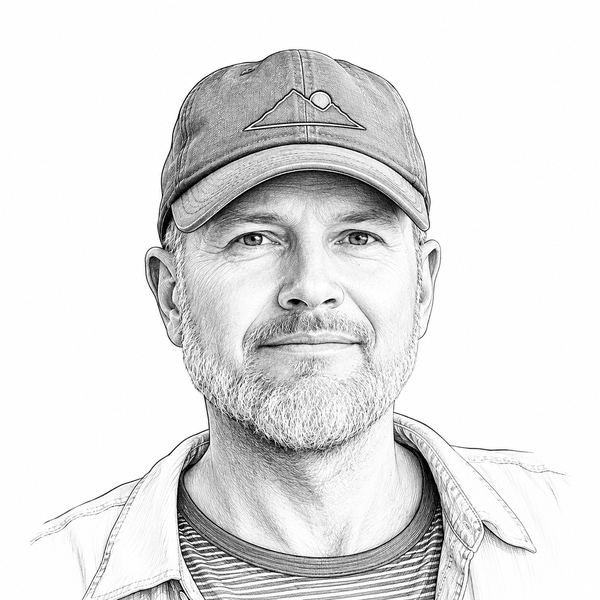
I spent twenty-five years as a federal trial lawyer. I know what a career’s worth of judgment looks like, and I know how completely it disappears when someone packs up their office. The legacy-preservation work — the LegacyView studio, the archive, the AI-assisted preparation — is what I do now, and I built it because I kept watching the same loss happen to people I respected, and the technology finally arrived to do something about it.
You spent thirty or forty years building a body of work. The most expensive sentence in the language is I’ll get to it after I retire. The version of yourself that knows what the work was about is most available now, before the boxes get packed.
I’d like to help you not lose it.